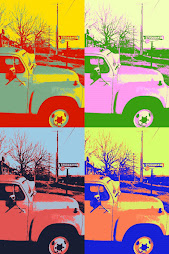
Anticpation
 and hope had always been the hallmark of the Studebaker organization. Two brothers, Henry and Clement Studebaker, set the company in motion in February, 1852, when they opened a
smal blacksmith shop in South Bend, Ind. At first they only produced a few hose drawn farm wagons, but with hard work and capital, and help from a third brother John M. ( who made a bundle building wheelbarrows for the
goldminers of California) they propelled the company to international
prominance. Not long after younger brothers Peter and Jacob joined the family organization, the Studebaker Brother Manufacturing Co. proclaiming that it was the largest producer of horse drawn vehicles in the world.
Studebaker water wagon
Studebaker produced its first salable automobile, an electric, in 1902. It entered the gasoline automobile business in 1904. In late 1910, Studebaker
mergered with EMF Corp. to form Studebaker Corp. In 1915, the first non-family member, Albert R, Erskine, became president of the corporation. During this period,
Studebakers was, except for Ford,
amoung the largest producers of automobiles in the country. Sales increases continued at a steady clip until the stock market crash of 1929.
Erskine felt that the depression would be short lived, so he continued to distribute large dividends. Erskine's misjudgement led Studebaker into
recievership in 1933.Two resourceful Studebaker executives, Paul G, Hoffman and Harold S, Vance, pulled things together and saved the company. Hoffman and Vance guided the company through the depression and introduced the successful Champion model. They were still directing the company in 1945, when automobile production resumed.
Hoffman was president and Vance acted as Chairman of the board. Both men were responsible for Studebaker becoming the first established American automobile company to introduce a new postwar styling. A
stlylish new car and a seller's market helped Studebaker establish new sales and profit records during the late 40's.
Although Studebaker's image seemed
rosey, it was during this period that the seeds of the company's eventual undoing were taking root. A pampered work force and many outdated buildings resulted in poor productivity and high overhead. When the seller's market became the buyer's market, in the early 50's, these problems started to eat away at the profits. If the company had fed more profits back into plant improvements and taken a hard labor strike, things would have been much better. By 1953, the automobile division was operating in the red. Hoffman, who had left in 1948 to take a
goverment position, returned in 1953. Neither him nor Vance could stop the flow of red ink.
Low slung new styling in 1953, a takeover by Packard in 1954, and help from Curtis-Wright in 1956, just prolonged what most insiders felt was a hopeless cause. The formation of Studebaker-Packard Corp. brought in James Nance as chief
execustive officer. Two years later, under the guidance of Curtis-Wright, Harold Churchill was selected as Studebaker-Packard's new president. This was a wise choice. Churchill an engineer, was a loyal Studebaker man who had been with the corporation since 1926. He was determined to see to it that the company survived.
In late 1958 Churchill introduced the Lark. This first compact car proved to be a big success during it's first year.
Chuchill wanted to use the 1959 profits to keep Studebaker in the forefront of small car development. However the board of directors
prefered using most of the profits for diversification. This difference of
opinon resulted in the early 1961 replacement of Churchill with Sherwood Egbert.
Egbert working within the constrictions of the board, also hoped to save the automobile division. His efforts fostered the creation of the Gran
Turismo Hawk and the
Avanti. Egbert's achievements, although commendable, did not help Studebaker's position. It was again on the
negitive side of the profit scale. The Packard name was dropped in 1962.
In late 1963, Egbert stepped down because of failing health.
Studebakers directors voted to close down most of the South Bend,
INd. facility. Production was then centralized at the Hamilton plant, in Ontario, Canada. President of the Hamilton
divison was Gordon Grundy. He tried his best to operate the facility in the black. He did manage make small profits, but not enough to satisfy the board of directors. Because of the boards dissatisfaction, the Canadian plant was closed in March 1966. By early 1966, the corporation's other diversified holdings, including
STP, represented a majority of Studebaker sales.
These other companies kept Studebaker going. In mid 1967, the Studebaker Corp. purchased the Wagner Electric Corp. and in November 1967 Studebaker combined with the Worthington Corp. to form Studebaker-Worthington. In the fall of 1979, the Studebaker-Worthington Corp. was absorbed by the smaller
McGraw-Edison Co. of Illinois. Cooper Industries took over
McGraw-Edison in 1985. Facts and taken from.......
http://www.automotivehistoryonline.com/Studebaker.htm. In 2010 Phoenix will host the Studebaker International meet. Rumor has it that some of the the give awayS will include two models of Studebaker wagon, and one is a Water wagon.
Hmmmm! I WONDER IF I COULD START BUYING TICKETS NOW?

 Last week, John was fortunate enough to attend a few days of the International Studebaker Meet in Cedar Rapids, Iowa. One of the highlights of his journey was having the opportunity to see Les Hole's '55 truck.
  Although we enjoy and appreciate our truck for what it is, we have nothing but admiration and awe for this stock version of the same year and model.
 John even got to see the engine compartment as it was meant to be...Studebaker engine and all!
 Perhaps the best part of the whole encounter was meeting this truck's owner and hearing his passion for his Stude. He was even so generous as to give John a past copy of Turning Wheels that featured '55 trucks. Thanks, Les! It was a pleasure meeting you and seeing your truck!